
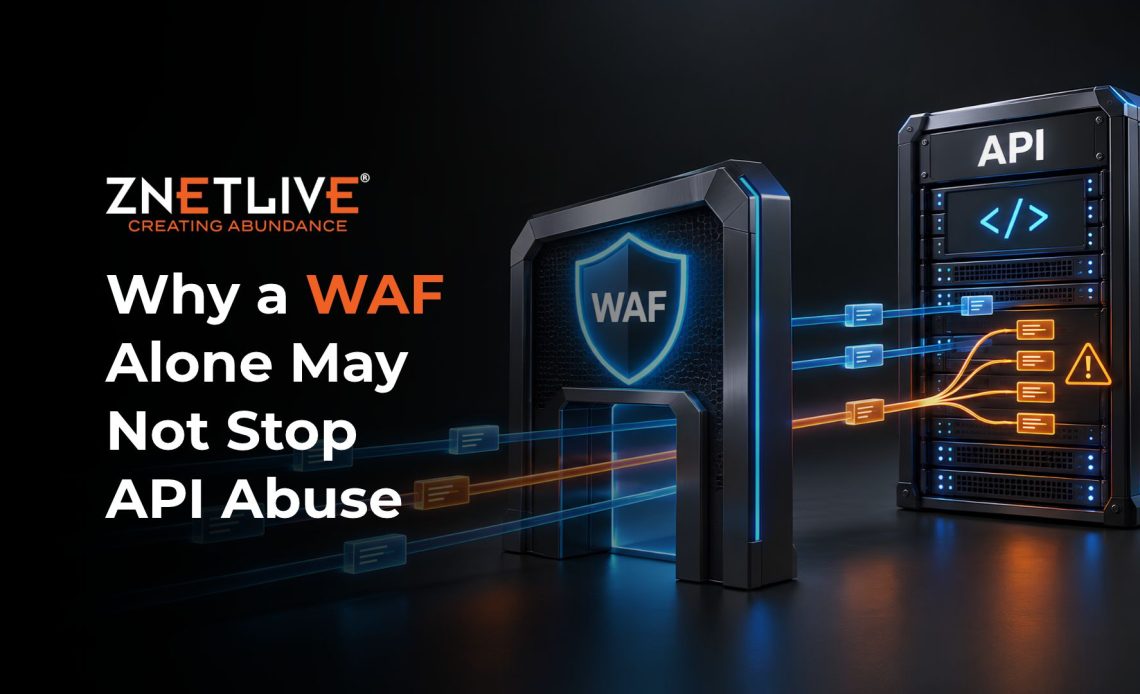
A web application firewall (WAF) helps filter malicious web traffic, but API abuse can use valid credentials and permitted requests to misuse data or business workflows. Teams addressing AI API security risks also need API discovery, server-side authorisation, behavioural analysis and a tested response process.
Through our Akamai solutions, we help security teams scope API security assessments and evaluate Akamai protections alongside their existing WAF.
This guide explains WAF coverage, common abuse patterns and the checks security teams should prioritise before selecting additional controls.
ZNetLive is an Akamai distributor, and this article cites Akamai’s research alongside independent guidance from OWASP and NIST.
Why Can API Abuse Get Past a WAF?
API abuse can exploit the meaning of an allowed action rather than a recognisably malicious payload. A request may be correctly formatted and authenticated, yet retrieve another customer’s records or repeat a permitted action excessively.
A WAF typically inspects HTTP traffic and applies configured protections against threats such as injection attacks; our guide on how Akamai WAF protects modern applications explains this layer in detail. Modern web application and API protection (WAAP) platforms can add schema validation, API controls and bot defences, so capabilities differ between products and deployments.
The key question is whether your deployed controls understand the user, the requested resource and the expected business outcome. An inspection rule alone cannot supply missing ownership checks inside an application.
NIST’s guidelines for API protection describe WAFs as a useful protection layer within a broader API security approach. Assess your actual configuration and traffic coverage before assuming that a WAF subscription provides complete API protection.
Which API Abuse Patterns Should Security Teams Test?
The OWASP API Security Top 10, 2023 edition provides a practical framework for reviewing authorisation, authentication, business flows and API inventory. The following table highlights relevant risks rather than reproducing the complete list.
| Abuse pattern | Relevant OWASP category | Control to examine |
| Access to another customer’s object | API1: Broken Object Level Authorization | Ownership and tenant checks on every resource request |
| Compromised authentication | API2: Broken Authentication | Token validation, account protection and session controls |
| Changes to restricted fields | API3: Broken Object Property Level Authorization | Permissions for each exposed or editable property |
| Excessive paid operations | API4: Unrestricted Resource Consumption | Resource budgets, quotas and operation limits |
| Automated misuse of a permitted workflow | API6: Unrestricted Access to Sensitive Business Flows | Business rules and abuse controls |
| Forgotten or deprecated endpoints | API9: Improper Inventory Management | Current inventory, ownership and retirement controls |
How Does Broken Object-Level Authorisation Work?
Broken object-level authorisation (BOLA) occurs when an API fails to verify access to a specific object. A successful login establishes identity; it does not grant access to every record.
OWASP’s BOLA examples include access to other shops’ revenue information through manipulated identifiers. A comparable business scenario is an authenticated customer receiving another customer’s invoice because the application omits an ownership check.
The request may satisfy a schema and contain no injection payload. Enforce authorisation on the server, then test access across users, roles and tenants using authorised test accounts.
Why Can Credential Stuffing Look Like Normal Login Traffic?
Credential stuffing uses stolen username and password pairs against another service, exploiting credential reuse. Individual login attempts can resemble ordinary authentication requests even when the wider campaign is malicious.
The OWASP credential stuffing prevention guidance recommends layered defences and explains why an IP-based limit alone can be insufficient. Consider multifactor authentication, account and device signals, bot controls and monitoring across successful and failed logins.
A stolen API token presents a related credential misuse risk, but it is not credential stuffing. Token scope, expiry, revocation and subsequent account activity need their own checks.
How Can Scraping and Workflow Abuse Use Permitted Requests?
A scraper can repeatedly call an allowed endpoint to harvest information, while workflow abuse repeatedly exploits a legitimate business action. A single request may be acceptable even when the overall pattern harms the organisation.
Akamai’s Lurking in the Shadows research, published in March 2024, describes authenticated API scraping and runtime signals such as unusual JSON properties. These are documented abuse patterns; the invoice scenario above is illustrative, not a reported customer breach.
OWASP also describes harmful automation in its sensitive business flows guidance, including excessive use of purchasing and reservation functions. Define acceptable behaviour for each valuable workflow and monitor activity across accounts and sessions.
How Do AI API Security Risks Change the Assessment?
AI API security risks include exposure through AI-connected applications and the potential acceleration of API reconnaissance and abuse. The underlying questions remain practical: who can access data, which actions are allowed and how much activity is acceptable?
As of November 2026, Akamai describes AI-assisted reconnaissance and business-logic probing among the threats addressed by its API security approach. That does not establish that every suspicious request is AI-generated, or that AI creates every authorisation flaw.
An AI assistant with access to customer systems should have narrowly scoped credentials and enforceable permissions for each action. Teams should also review sensitive data returned to AI workflows and set appropriate consumption budgets for paid operations.
Our guide to NVIDIA and Akamai Cloud for production AI covers the infrastructure side of these deployments. API access controls and abuse monitoring should be part of the application’s security design.
How Should WAF, API Security and Application Controls Work Together?
A layered design assigns each control a clear job and connects detection to an accountable response owner. The following comparison describes typical roles; specific capabilities depend on the selected products and configuration.
| Layer | Main role | Validation question |
| WAF or WAAP | Inspect protected traffic and enforce configured threat policies | Which routes, hosts and API protections are enabled? |
| API gateway | Apply configured access, routing, schema and quota policies | Can requests reach an unprotected origin or older route? |
| Dedicated API security | Discover APIs, assess posture and analyse runtime behaviour | Which traffic sources and API environments are connected? |
| Application and identity controls | Enforce resource permissions and business rules | Are user, tenant, object and action permissions checked? |
| Security operations | Investigate evidence and coordinate containment | Who revokes credentials, applies controls and validates recovery? |
A detection should lead to an agreed action, such as a developer fix, credential revocation or an approved gateway policy. Test that action against legitimate users before applying broad production restrictions.
How Does Akamai API Security Complement a WAF?
As of November 2026, Akamai API Security supports API discovery, posture assessment, runtime behavioural analysis, and active testing. It can analyse APIs beyond traffic routed through an Akamai CDN, subject to supported data connections.
Akamai distinguishes this product from App & API Protector, its WAAP solution for inline edge protection. The combination can connect API risk insight with protection for relevant edge traffic.
Akamai’s API Security reference architecture shows a traffic copy feeding analysis and response through integrations, including the Akamai edge. Detection and inline blocking are separate functions, so confirm the intended enforcement path during solution design.
For your evaluation, ask us to map priority APIs, available traffic sources, sensitive-data handling and response integrations. A useful demonstration should show an actionable finding with enough evidence for your security and application teams to investigate.
What Should an API Security Assessment Include?
Start with a critical customer or partner workflow and agree the assessment boundaries before connecting data or testing behaviour. Use the checklist below to define evidence your team can review.
- Identify API owners: Record active endpoints, versions, environments and the teams responsible for remediation.
- Trace sensitive data: Establish which responses expose customer, financial or internal information and who should receive it.
- Test authorisation: Check object, property and function permissions across approved test users and tenants.
- Review abuse controls: Examine authentication attempts, repeated business actions, scraping patterns and consumption limits.
- Check response readiness: Confirm alert routing, investigation access, credential revocation and enforcement ownership.
- Agree success criteria: Require prioritised findings, assigned owners and a retest plan for confirmed fixes.
Include API owners, security operations and application engineering in the review so findings translate into changes. An assessment is most useful when the team can explain both the risk and the proposed corrective action.
Frequently Asked Questions
These answers clarify common decisions about WAF coverage and additional API protection.
1. Can a WAF Protect APIs?
Yes. A WAF can protect covered API traffic against configured threats, and some platforms include specialised API controls. Confirm enabled capabilities, traffic coverage and application authorisation rather than relying on the product label.
2. Is an API Gateway Enough for API Security?
A gateway provides important access and traffic policies, but its effectiveness depends on configuration and route coverage. Review application permissions, API inventory, abuse detection and incident response alongside gateway controls.
3. Does a Valid API Token Prove a Request Is Safe?
No. A token may be stolen, overly privileged or used to access a resource outside the caller’s permissions. Validate token scope and enforce server-side authorisation for each protected action.
4. Can API Abuse Happen Without AI?
Yes. Authorisation failures, credential misuse and harmful automation also occur without AI. AI adds assessment considerations around connected workflows and accelerated abuse, while existing access and business-rule controls remain essential.
5. Should We Replace Our WAF With API Security?
Assess complementary coverage first. Keep effective traffic protection while addressing gaps in discovery, authorisation testing and behaviour analysis, with a clear response path for confirmed abuse.
6. How Can We Request an API Security Assessment?
Contact ZNetLive with a priority workflow, your current WAF or gateway and the environments involved. We can discuss assessment scope and the information needed to evaluate a suitable approach.
What Should Your Team Prioritise Next?
Choose a business-critical workflow and establish whether your current controls can explain who accessed each resource and why the action was permitted. Address missing authorisation checks, visibility gaps and response ownership before expanding the assessment to additional APIs.
