
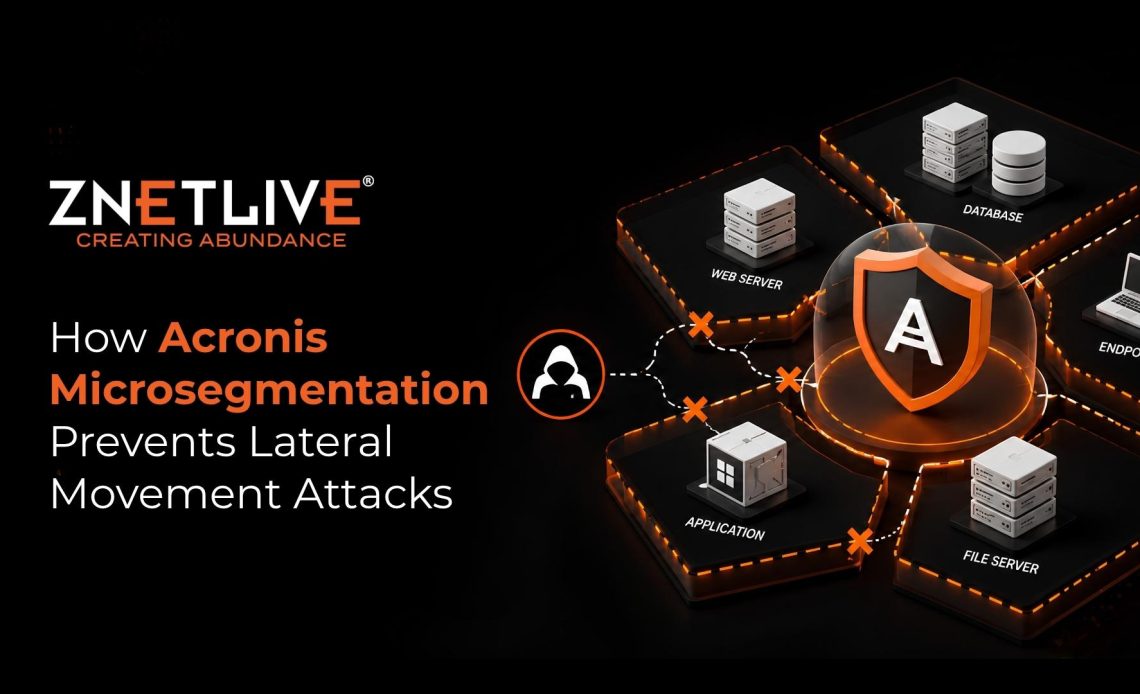
Cyberattacks rarely stop at the first compromised device. Once attackers gain access to a network, their next goal is to move sideways, discover valuable assets, and expand their control.
This tactic is known as lateral movement, and it is one of the biggest reasons why ransomware attacks become major security incidents.
Recent industry research found that 95% of security leaders consider microsegmentation critical for strengthening cyber defenses, yet only 5% of organizations have fully implemented it.
This gap leaves many businesses vulnerable to lateral movement attacks and unnecessary risk. Traditional network security often focuses on protecting the perimeter.
However, today’s distributed IT environments require more granular protection. This is where Acronis Microsegmentation helps organizations isolate workloads, enforce access controls, and stop threats before they spread.
What Is Microsegmentation?
Before understanding how Acronis stops lateral movement, it is important to answer a common question: what is microsegmentation?
Microsegmentation is a security approach that divides a network into smaller, isolated zones. Each segment has its own security policies and access controls.
Instead of allowing unrestricted communication across the network, microsegmentation restricts traffic based on business requirements and security rules.
For example, an employee workstation may need access to an application server but not to financial databases or backup repositories. Microsegmentation enforces these boundaries automatically.
The result is better visibility, stronger control, and reduced risk. Unlike traditional network segmentation that separates large network sections, network microsegmentation protects individual workloads, applications, virtual machines, servers, and endpoints.
Why Lateral Movement Is Dangerous?
Most successful cyberattacks follow a similar pattern. An attacker gains access through a phishing email, compromised credentials, software vulnerability, or infected endpoint.
Once inside, the attacker explores the environment and looks for opportunities to expand access. This process is called lateral movement.
Common lateral movement techniques include:
- Credential theft
- Remote desktop abuse
- Pass-the-hash attacks
- Privilege escalation
- Exploitation of trusted connections
- Internal reconnaissance
Attackers use these methods to move from one system to another until they reach critical assets. Without proper segmentation, a single compromised device can expose an entire organization.
This is why many security experts consider lateral movement one of the most dangerous stages of a cyberattack.
What is the Connection Between Microsegmentation and Zero Trust?
Modern security frameworks increasingly rely on the principle of “never trust, always verify”. This philosophy forms the foundation of Zero Trust security.
A microsegmentation zero trust strategy assumes that no user, device, application, or workload should receive unrestricted access.
- Every communication request must be verified.
- Every access attempt must be validated.
- Every connection must follow predefined security policies.
Microsegmentation supports Zero Trust by creating boundaries that limit unnecessary communication between systems.
Even if attackers gain access to one segment, they cannot freely move across the network. This significantly reduces the impact of a breach.
How Acronis Microsegmentation Works
Acronis combines cyber protection, endpoint security, and advanced segmentation capabilities to strengthen organizational defenses.
Instead of relying solely on perimeter controls, Acronis creates security boundaries around workloads, applications, and endpoints.
Acronis Microsegmentation focuses on three key areas:
1. Granular Workload Isolation
Acronis isolates critical assets into secure segments. Each segment receives customized access policies based on business requirements.
Only authorized users, applications, and services can communicate within those environments. This approach limits exposure and reduces unnecessary network access.
2. Policy-Based Traffic Control
Acronis continuously evaluates traffic between systems. Security teams can define rules that determine which workloads can communicate with each other.
Unauthorized connections are automatically blocked. This prevents attackers from using compromised devices as launch points for broader attacks.
3. Real-Time Visibility
Visibility is essential for effective segmentation. Acronis provides insights into application dependencies, network communications, and workload interactions.
Security teams can identify unusual activity quickly and respond before threats spread.
How Acronis Prevents Lateral Movement Attacks
The primary objective of microsegmentation is simple. Stop attackers from moving beyond the initial point of compromise. Here is how Acronis achieves that goal:
- Restricts Unnecessary Network Access
Many organizations operate with overly permissive network policies. Devices often communicate with systems they do not actually need.
Acronis limits communication paths and enforces least-privilege access. When attackers compromise one endpoint, they encounter strict boundaries that prevent further expansion.
- Contains Breaches Within Isolated Segments
A breach does not automatically become a network-wide incident. Acronis keeps workloads separated through controlled segmentation.
If malware infects one segment, the threat remains confined to that area. Critical systems stay protected, and business operations continue with minimal disruption.
- Protects High-Value Assets
Databases, backup repositories, domain controllers, and business-critical applications are common attacker targets.
Acronis places these assets inside protected segments with stricter security controls. Unauthorized access attempts are blocked before attackers can reach sensitive resources.
- Reduces the Attack Surface
Every unnecessary connection creates a risk. Acronis helps organizations eliminate excess communication pathways.
This reduces opportunities for exploitation and strengthens overall security posture.
- Supports Faster Incident Response
Security teams can quickly identify affected segments and isolate them if suspicious activity appears. Containment becomes faster and more effective. This minimizes operational impact and accelerates recovery efforts.
5 Key Benefits of Acronis Microsegmentation
Organizations adopting micro segmentation solutions often experience significant security improvements. Some of the most important benefits include:
1. Improved Cyber Resilience
A successful attack does not automatically become a catastrophic breach. Threats remain contained within restricted environments. You can learn more about building cyber resilience for SMBs with Acronis here.
2. Stronger Ransomware Protection
Ransomware operators depend heavily on lateral movement. Acronis limits their ability to spread across systems and encrypt additional assets.
3. Better Regulatory Compliance
Many compliance frameworks require organizations to protect sensitive data through access controls and segmentation. Microsegmentation helps support these requirements.
4. Enhanced Visibility
Security teams gain a deeper understanding of network traffic and workload interactions. This improves threat detection and operational awareness.
5. Reduced Operational Risk
Effective control over communication between systems reduces the risk of accidental exposure and unauthorized access.
How Acronis Compares with Other Microsegmentation Vendors
The market includes several microsegmentation vendors that offer segmentation capabilities for enterprise environments. However, many solutions focus only on network segmentation.
Acronis takes a broader approach by combining cybersecurity, endpoint protection, backup, disaster recovery, and segmentation within a unified platform.
This integrated model offers several advantages:
- Simplified security management
- Centralized visibility
- Reduced tool sprawl
- Faster deployment
- Improved cyber resilience
Organizations can strengthen protection without introducing unnecessary complexity.
Best Practices for Successful Microsegmentation
Technology alone is not enough. Organizations should follow proven best practices when implementing microsegmentation software.
- Understand Application Dependencies: Map communications between applications, workloads, and services before creating segmentation policies.
- Apply Least-Privilege Access: Allow only the traffic required for business operations. Block everything else.
- Protect Critical Assets First: Focus on initial segmentation efforts on high-value systems and sensitive data.
- Continuously Monitor Activity: Threats evolve constantly. Regular monitoring helps identify suspicious behavior and policy gaps.
- Align Segmentation with Zero Trust: Build segmentation policies that support broader Zero Trust objectives. This improves long-term security effectiveness.
Why Microsegmentation Is Essential for Modern Security
The cybersecurity landscape continues to evolve. Organizations face increasingly sophisticated threats that bypass traditional perimeter defenses.
Remote work, cloud adoption, and interconnected environments create new attack paths. Network microsegmentation addresses these challenges by limiting attacker mobility and enforcing strict access controls.
Instead of assuming that internal traffic is trustworthy, organizations can verify every connection and reduce exposure across the environment. This shift supports stronger cyber resilience and better protection against modern threats.
Strengthen Your Security with Acronis Microsegmentation
Lateral movement remains one of the most effective techniques used by cybercriminals. Once attackers gain access, they look for opportunities to move deeper into the network and reach valuable assets.
Acronis Microsegmentation helps stop that progression. Organizations can contain threats before they spread through workload isolation, access controls, and a microsegmentation zero trust strategy.
The result is stronger protection, faster incident response, and improved business continuity.
If your organization is looking for advanced micro segmentation solutions that reduce risk and strengthen cyber resilience, Acronis provides the tools needed to protect today’s complex IT environments.
Explore these additional resources from ZNetLive to strengthen your cyber protection strategy:
- Acronis Cyber Protect Cloud
- Acronis Advanced Security Solutions
- Microsoft 365 Backup with Acronis
- Disaster Recovery Solutions
- Ransomware Protection Best Practices
- Business Continuity and Data Protection Solutions.
These resources can help you build a comprehensive cybersecurity framework that goes beyond traditional defenses.
Conclusion
Lateral movement remains one of the most critical challenges in modern cybersecurity, often turning minor breaches into major incidents. Microsegmentation plays a vital role in preventing this by restricting unnecessary communication and enforcing strict access controls across environments.
With Acronis Microsegmentation, organizations gain the ability to isolate workloads, contain threats, and protect critical assets more effectively. This approach not only limits the impact of attacks but also strengthens overall cyber resilience in increasingly complex IT environments.