
Modern IT environments demand simplicity, scalability, and reliable performance.
Traditional infrastructure often struggles to keep pace with these expectations because compute, storage, and networking remain separate systems that require extensive management. This challenge has accelerated the adoption of Hyperconverged Infrastructure (HCI).
In fact, the global HCI market was valued at approximately USD 15.13 billion in 2025 and is projected to reach USD 70.5 billion by 2034, highlighting the growing demand for simplified infrastructure solutions.
Among the leaders in this space, Nutanix has become a widely recognized name. This guide explains what Nutanix is, how it works, and why organizations increasingly choose it to modernize their IT infrastructure.
What Is Nutanix?
Nutanix is a cloud software company best known for its hyperconverged infrastructure (HCI) platform, which unifies compute, storage, virtualization, and management into a single solution.
Its primary goal is to simplify how organizations build, operate, and scale IT environments.
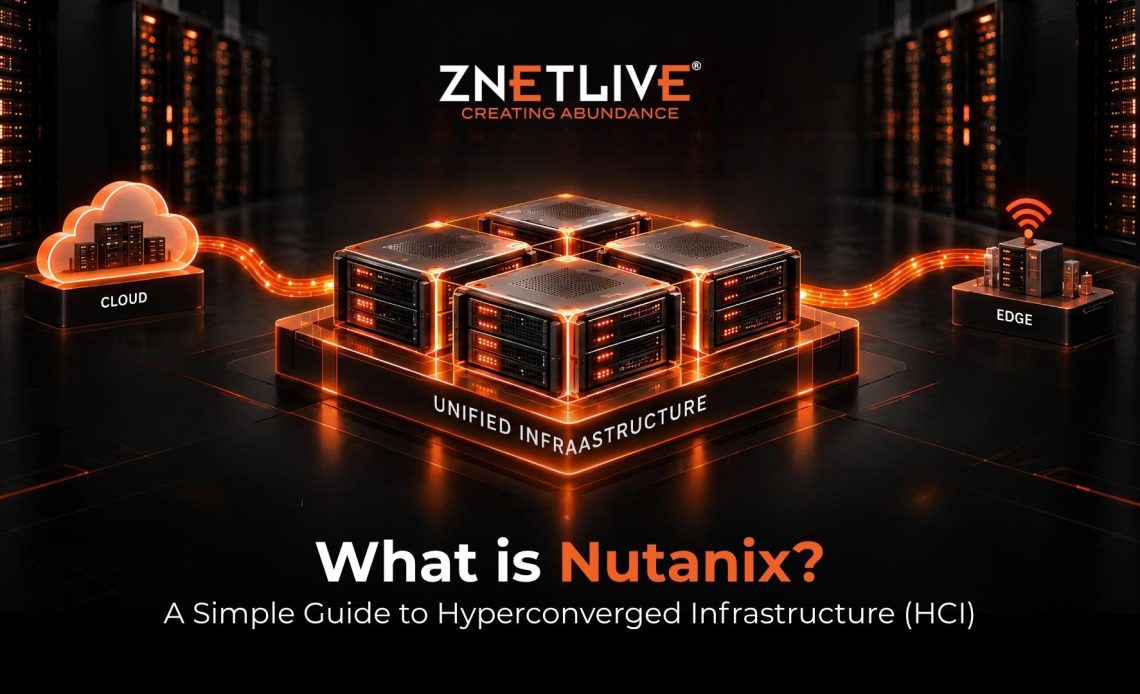
Rather than relying on multiple standalone systems, Nutanix creates a unified platform that delivers a cloud-like operational experience across on-premises, edge, and hybrid environments.
How Nutanix Works
Nutanix uses a distributed software architecture that runs across a cluster of servers.
The platform brings together:
- Compute resources
- Storage resources
- Virtualization services
- Management capabilities
Administrators can control and monitor the environment through a centralized management console, reducing the time required for routine operations.
Core Components of the Nutanix Platform
Several technologies work together to power the Nutanix platform, such as:
1. Nutanix AOS (Acropolis Operating System)
AOS is the core software layer of Nutanix. It provides software-defined storage, manages infrastructure resources, and enables data services such as replication, resilience, and storage optimization.
2. AHV Hypervisor
AHV is Nutanix’s built-in virtualization platform. It allows organizations to create and manage virtual machines without relying on third-party hypervisors, helping reduce complexity and licensing costs.
3. Prism
Prism is Nutanix’s centralized management console. It provides a single interface for monitoring, automation, reporting, performance tracking, and day-to-day administration.
4. Flow
Nutanix Flow strengthens security through network micro-segmentation. It helps organizations control traffic between workloads, improve visibility, and reduce potential security risks.
5. Files, Objects, and Database Services
These services support enterprise data and application requirements. Nutanix Files provides file storage, Objects supports object storage workloads, and Database Services simplify database deployment and management.
Key Features of Nutanix
Nutanix stands out because of its focus on simplicity and flexibility.
-
Unified Management
Prism allows administrators to manage infrastructure, storage, virtualization, and health monitoring from a single dashboard.
This centralized visibility reduces administrative overhead and improves operational efficiency.
-
Built-In Security and Resilience
Security remains a priority in modern IT environments.
Nutanix includes capabilities such as:
- Role-based access controls
- Data encryption
- Automated recovery options
- Micro-segmentation
- Compliance support
These features help strengthen security without increasing complexity.
-
Scalability on Demand
Infrastructure requirements often evolve rapidly.
Nutanix enables organizations to scale resources incrementally by adding nodes whenever additional capacity is required.
This approach eliminates large upfront investments and reduces capacity planning challenges.
-
Multi-Cloud Flexibility
Many businesses operate across a mix of environments.
Nutanix supports:
- Private clouds
- Public clouds
- Hybrid cloud models
- Edge deployments
This flexibility helps organizations maintain consistent operations regardless of deployment location.
What is Nutanix HCI?
Nutanix HCI is a software-defined infrastructure platform that combines compute, storage, networking, and virtualization into a unified environment managed through a centralized interface.
It simplifies data center management, improves scalability, and enables organizations to run applications more efficiently through a unified management interface.
Benefits of Using Nutanix HCI
Technology decisions ultimately come down to business value. Nutanix delivers several practical benefits.
1. Simplified IT Operations
Administrators can manage infrastructure through a centralized platform rather than coordinating multiple vendor tools.
This simplicity reduces management effort and accelerates routine tasks.
2. Reduced Infrastructure Costs
Organizations often experience cost savings through:
- Lower hardware requirements
- Reduced operational overhead
- Simplified maintenance
- Better resource utilization
Cost optimization becomes especially valuable as infrastructure requirements grow.
3. Improved Performance and Availability
The distributed architecture helps organizations maintain performance while supporting high availability.
Built-in redundancy also supports business continuity objectives.
4. Faster Deployment and Management
Traditional infrastructure deployments can take weeks or months.
Nutanix environments can often be deployed significantly faster, helping businesses respond quickly to changing requirements.
It shifts infrastructure management from hardware-centric operations to software-driven administration, allowing IT teams to focus more on innovation and less on maintenance.
Nutanix vs Traditional Three-Tier Infrastructure
The differences become clearer when viewed side by side.
| Feature | Traditional Infrastructure | Nutanix HCI |
| Management | Multiple consoles | Unified console |
| Scalability | Complex upgrades | Add nodes easily |
| Deployment Time | Longer | Faster |
| Hardware Requirements | Separate components | Consolidated platform |
| Operational Complexity | High | Lower |
| Maintenance Effort | Extensive | Simplified |
| Cloud Integration | Limited | Built for hybrid cloud |
For many organizations, these advantages translate into faster operations and improved agility.
Common Nutanix Use Cases
Nutanix supports a wide range of business and enterprise workloads.
-
Virtual Desktop Infrastructure (VDI)
Organizations use Nutanix to deliver virtual desktops with consistent performance and simplified management.
-
Disaster Recovery
Built-in replication and recovery capabilities help businesses protect critical workloads and reduce downtime risks.
-
Database Workloads
Many enterprises run databases on Nutanix due to its scalability and performance optimization capabilities.
-
Private and Hybrid Cloud Environments
Organizations looking to modernize their infrastructure often use Nutanix as a foundation for private and hybrid cloud strategies.
Is Nutanix the Right Choice for Your Business?
Not every infrastructure solution fits every organization.
Before making a decision, consider:
- Current infrastructure complexity
- Growth expectations
- Cloud adoption plans
- Disaster recovery requirements
- IT team resources
- Budget considerations
When Nutanix Makes Sense
Nutanix is often a strong fit when organizations want to:
- Simplify infrastructure management.
- Consolidate multiple systems.
- Support hybrid cloud initiatives.
- Improve scalability.
- Reduce operational complexity.
A thorough assessment of business goals and technical requirements can help determine whether the platform aligns with long-term objectives.
Simplify Nutanix Adoption with ZNet
Nutanix offers a powerful foundation for modern infrastructure, but achieving the best results requires the right deployment strategy and ongoing expertise.
As a Nutanix partner, ZNet helps organizations design, deploy, optimize, and manage Nutanix-powered infrastructure environments. Our team works closely with businesses to simplify operations, improve scalability, and support hybrid cloud initiatives.
Whether your goal is data center modernization, infrastructure consolidation, disaster recovery, or hybrid cloud adoption, ZNet can help you maximize the value of your Nutanix investment through expert guidance and support.
Conclusion
Nutanix has transformed infrastructure management by bringing compute, storage, virtualization, and management together in a unified software-defined platform. Its hyperconverged architecture helps organizations simplify operations, improve scalability, strengthen resilience, and support hybrid cloud strategies.
As IT environments continue to evolve, organizations need infrastructure solutions that can reduce complexity while supporting growth and innovation. Nutanix provides a flexible and scalable foundation for running modern workloads across on-premises, edge, and cloud environments.
As a Nutanix partner, ZNet helps businesses evaluate, deploy, and optimize Nutanix solutions that align with their unique infrastructure goals. Contact ZNet’s experts to explore how Nutanix can support your cloud modernization and digital transformation initiatives.

